In the competitive world of online automotive retail, accuracy and user experience are everything. One of the most powerful tools enabling both is the auto parts fitment database—the backbone behind the familiar “Find Parts for Your Vehicle” search bar seen on most eCommerce auto parts websites.
This feature is more than just a convenience. It is a critical system that ensures customers find the right parts quickly, reduces costly returns, and builds long-term trust in your brand.
What Is an Auto Parts Fitment Database?
An auto parts fitment database is a structured dataset that maps automotive parts to specific vehicles based on attributes such as:
- Make (e.g., Honda)
- Model (e.g., Civic)
- Year (e.g., 2025)
- Engine type
- Trim level
- Region-specific variations
Instead of showing all available products, the database filters and displays only those parts that are compatible with a selected vehicle.
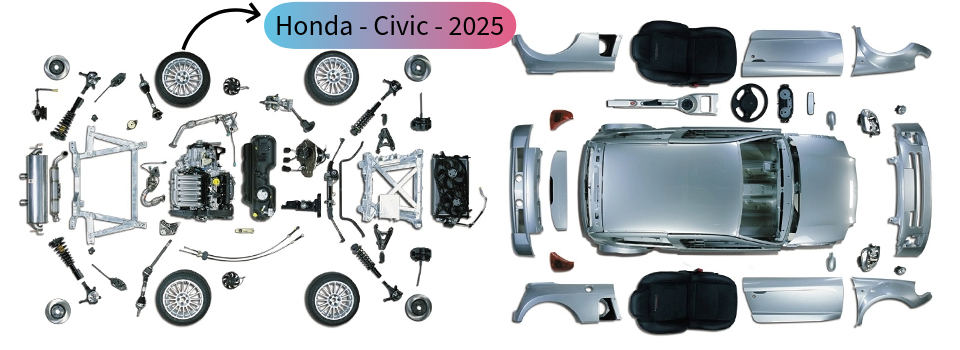
Core Use Case: “Find Parts for Your Vehicle”
Scenario
A shopper visits an auto parts website looking for brake pads for their 2025 Honda Civic.
How It Works
- The user enters vehicle details using the search bar:
- Year: 2019
- Make: Honda
- Model: Civic
- The auto parts fitment database processes this input.
- It cross-references millions of product records and filters results based on compatibility rules.
- The website displays only brake pads that are confirmed to fit the selected vehicle.
Instead of overwhelming the customer with thousands of generic options, the system delivers a refined, relevant product list in seconds.
Why This Matters for Auto Parts eCommerce
1. Eliminates Guesswork
Without a fitment database, customers must manually verify compatibility—often leading to confusion and errors. Fitment data removes that uncertainty by showing only validated matches.
2. Reduces Incorrect Purchases
Incorrect part orders are one of the biggest challenges in auto parts retail. By filtering products based on vehicle compatibility, businesses can significantly reduce mismatch issues.
3. Lowers Return Rates
Returns are expensive—not just financially, but operationally. A robust auto parts fitment database minimizes returns by ensuring customers buy the correct part the first time.
4. Improves Customer Experience
A smooth, accurate search experience builds confidence. When customers consistently find the right parts quickly, they are more likely to return.
5. Increases Conversion Rates
Relevant search results lead to faster decision-making. The fewer obstacles a customer faces, the higher the likelihood of completing a purchase.
Behind the Scenes: What Makes It Work
To deliver accurate results, a fitment database relies on:
- Normalized vehicle data across multiple markets
- Standardized part compatibility mappings
- Regular updates for new models and aftermarket parts
- Integration with eCommerce platforms like Magento or WooCommerce
- High-performance indexing for real-time filtering
For large catalogs, this often means handling millions of fitment relationships efficiently.
Best Practices for Implementation
If you’re planning to implement or improve a fitment system, consider the following:
- Use structured data formats (like ACES/PIES where applicable)
- Ensure compatibility logic is precise and validated
- Optimize database queries for speed
- Provide fallback options (e.g., manual search by SKU)
- Continuously update vehicle and parts data
Final Thoughts
The “Find Parts for Your Vehicle” feature may seem simple on the surface, but it is powered by a highly sophisticated auto parts fitment database. For online auto parts retailers, this system is not optional—it is essential.
By investing in accurate and scalable fitment data, businesses can improve customer satisfaction, reduce operational costs, and gain a competitive edge in the market.
